Summary:
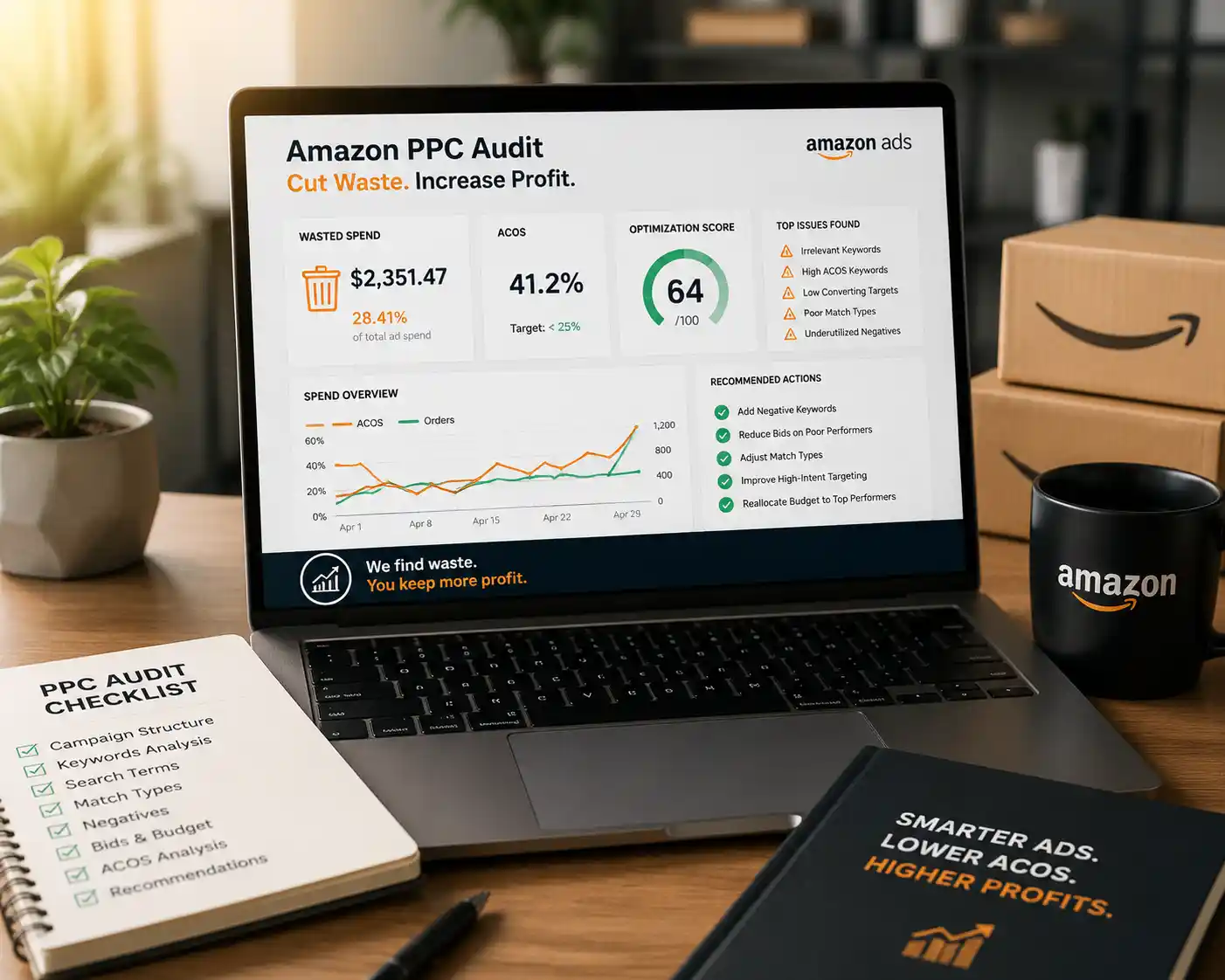
Running Amazon PPC in the US marketplace without regular campaign audits often leads to burning 25% to 45% of total ad spend on non-converting search terms, flawed match-type structures, and aggressive dynamic bidding. This complete guide walks small business owners through a 30-point diagnostic framework to eliminate ad waste, optimize TACoS, and reclaim net profit margins.
Running Amazon ads in the competitive US marketplace is getting increasingly expensive. Between rising Cost Per Click (CPC) rates, aggressive competitor bidding, and Amazon’s default settings that push impression volume over seller profitability, small business ad budgets can disappear quickly.
For most private label sellers and brand owners, the issue isn’t a lack of traffic it’s wasted ad spend. Account diagnostics consistently reveal that 25% to 45% of an Amazon ad budget goes toward non-converting search terms, duplicate keyword targeting, and misallocated daily budgets.
If your Advertising Cost of Sales (ACoS) is climbing while your net profit margins shrink, your account needs a structural diagnostic. Investing in a systematic amazon ppc audit service for small business allows you to identify budget leaks, isolate high-converting targets, and reallocate every ad dollar toward measurable growth.
Below is the exact step-by-step framework used by top performance marketers to reduce wasted ad spend on Amazon and build a scalable ad engine.
Step 0: The Retail Readiness Check
Before modifying bids or adjusting campaign settings, verify that your product detail pages are fully optimized to convert traffic. Sending paid clicks to an unoptimized listing wastes money regardless of your campaign structure.
Essential Retail Readiness Requirements:
- Buy Box Ownership: Must maintain 95% or higher. If you lose the Buy Box, Sponsored Products stop running automatically, but Sponsored Brands can continue spending without generating sales.
- Review Count & Star Rating: Minimum 30 verified customer reviews with at least a 4.2-star average. Listings below 4.0 stars suffer from low conversion rates and inflated ACoS.
- Listing Content & Visuals: High-resolution main image on a pure white background, mobile-optimized bullet points, and complete A+ Content.
- Keyword Indexation: Ensure all primary keywords are properly indexed in both front-end copy and back-end search terms.
Step 1: Campaign Architecture & Structural Audits
Flawed campaign structure is a primary driver of wasted ad spend. When auto campaigns, broad match keywords, and exact match targets are combined into a single ad group, Amazon’s algorithm prioritizes high-volume, low-intent terms, which starves high-converting exact match keywords of daily budget.
1. Match Type & Intent Isolation
To control keyword bids effectively, structure campaigns by match type and purchasing intent:
- Auto Campaigns: Reserved exclusively for discovering new customer search queries. Sub-targeting groups (Close Match, Loose Match, Substitutes, Complements) should be isolated into separate ad groups.
- Manual Discovery Campaigns: Use broad and phrase match keywords to capture variations and long-tail terms at lower base bids.
- Manual Ranking Campaigns: Group high-performing exact match keywords into dedicated campaigns to control placement, budget, and bid adjustments directly.
2. Eliminating Keyword Cannibalization
Keyword cannibalization occurs when multiple ad groups or campaigns target the same keyword for the same ASIN. This setup forces your campaigns to bid against each other in the auction, artificially inflating CPCs.
3. Variation & ASIN Isolation
Grouping high-margin parent ASINs with low-margin child variations or unrelated products in one ad group limits account efficiency. Amazon typically allocates impressions to one dominant variation, leaving inventory for other SKUs unoptimized.
| Structural Metric | High Risk (Ad Spend Leakage) | Optimal Audit Target |
| Keywords Per Ad Group | > 30–50 mixed keywords | 5–10 tightly themed targets |
| Match Type Separation | Auto + Broad + Exact in 1 Ad Group | Isolated campaigns by match type |
| ASIN Grouping | Unrelated SKUs or variations combined | Single parent ASIN or SKU per campaign |
| Campaign Naming | Vague names (e.g., “Campaign 1”) | [Brand]-[ASIN]-[Match Type]-[Strategy] |
Step 2: Search Term Mining & Negative Keyword Strategy
Running an amazon sponsored products campaign audit relies heavily on analyzing the 60-day Search Term Report (STR). While targeted keywords represent what you bid on, search terms reflect the actual phrases customers enter on Amazon that trigger your ads.
The 10–15 Clicks Zero-Sales Rule
In your Search Term Report, filter for search terms that have received 10 to 15 clicks with $0 in sales.
- Calculation: Wasted Spend = Total Clicks Without Sales × Cost Per Click (CPC)
Search Term Optimization Action Plan:
- Apply Negative Exact Match: Add non-converting terms with 10+ clicks as Negative Exact targets at the campaign or ad group level.
- Apply Negative Phrase Match: If root words are fundamentally irrelevant to your product (e.g., “free,” “used,” “repair manual,” or incorrect materials like “plastic” for a metal product), add them as Negative Phrase across all discovery campaigns.
- Keyword Harvesting: Identify search terms that have generated at least 3 to 5 sales at or below your target ACoS in auto or broad campaigns. Harvest these terms into your exact match ranking campaigns, and add them as Negative Exact targets in the discovery campaigns to prevent internal overlap.
Step 3: High ACoS & Bidding Optimization Audit
Reducing bids across the board to control a high ACoS often backfires by cutting off traffic to your top-converting terms. A proper amazon ppc optimization audit evaluates dynamic bidding settings and placement modifiers to make targeted adjustments.
1. Dynamic Bidding Strategy Settings
- Dynamic Bids – Down Only: The standard setting for account stability. Amazon lowers your bid in real time when a search is less likely to result in a sale.
- Dynamic Bids – Up and Down: Amazon can increase your bid by up to 100% for Top of Search placements. Audit Check: If your listing conversion rate is low, “Up and Down” bidding can quickly inflate average CPCs and spend. Switch these campaigns to “Down Only” during account recovery.
- Fixed Bids: Amazon uses your precise bid regardless of conversion probability. Best reserved for brand defense or controlled exact-match ranking strategies.
2. Placement Modifier Evaluation
Review performance metrics across Amazon’s primary ad placements: Top of Search (First Page), Rest of Search, and Product Pages.
If Top of Search converts at 20% with a 22% ACoS, while Product Pages convert at 4% with a 70% ACoS, lower the campaign’s base bid and apply a placement modifier (+50% to +150%) specifically to Top of Search. This shifts budget toward your highest-converting ad placements.
Step 4: Budget Allocation & Portfolio Pacing
Exhausting daily campaign budgets early in the day creates an unseen revenue bottleneck. When high-ROAS campaigns run out of funds by noon, your products lose visibility during late afternoon and evening peak shopping hours in US time zones.
Recommended PPC Budget Allocation Strategy
| Ad Format | Recommended Budget Share | Primary Strategic Focus |
| Sponsored Products | 70% – 80% | Core Revenue & Keyword Ranking |
| Sponsored Brands | 10% – 15% | Brand Defense & Video Ads |
| Sponsored Display | 10% – 15% | Retargeting & Competitor Detail Pages |
Measuring ACoS vs. TACoS
To maintain net profitability, track both advertising metrics and overall account performance:
- ACoS (Advertising Cost of Sales):
(Ad Spend / Ad Revenue) × 100— Measures direct ad campaign efficiency. - TACoS (Total Advertising Cost of Sales):
(Ad Spend / Total Revenue) × 100— Measures how ad spend affects total business revenue and organic search ranking growth.
While ACoS tracks direct campaign efficiency, TACoS reveals how effectively ad spend drives overall catalog growth and organic keyword rank. A healthy, scaling account typically maintains a TACoS between 8% and 15%.
Complete 30-Point Amazon Advertising Audit Checklist
Use this amazon advertising audit checklist every 30 to 60 days to audit campaign health and locate inefficiencies.
| Section | Item # | Diagnostic Checkpoint | Benchmark / Target | Action Standard |
| Retail Readiness | 1 | Buy Box / Featured Offer | ≥ 95% ownership | Pause ads if Buy Box is lost |
| 2 | Listing Star Rating | ≥ 4.2 Stars | Pause non-performing ad targets | |
| 3 | Review Count | ≥ 30 verified reviews | Enroll in Amazon Vine | |
| 4 | Main Image Click-Through Rate | ≥ 0.4% category average | A/B test main image variation | |
| 5 | Backend Keyword Indexation | 250 bytes utilized | Clean up search term fields | |
| Campaign Setup | 6 | Match Type Separation | Auto, Broad, Exact separated | Restructure mixed ad groups |
| 7 | Keywords Per Ad Group | 5 to 15 terms maximum | Split bloated ad groups | |
| 8 | Product Isolation | Single parent SKU per campaign | Isolate product variations | |
| 9 | Campaign Naming Standard | Standardized naming convention | Update for clean filtering | |
| 10 | Target Overlap Check | Zero keyword overlap | Eliminate self-bidding | |
| Search Term Mining | 11 | Non-Converting Spend | 10+ clicks with $0 sales | Add Negative Exact match |
| 12 | Low CTR Search Terms | CTR < 0.15% on high impressions | Negate irrelevant terms | |
| 13 | Search Term Harvesting | 3+ sales at target ACoS | Migrate to Manual Exact | |
| 14 | Negative Exact Syncing | Harvested terms negated in Auto | Add negative targets to discovery | |
| 15 | Irrelevant Brand Targets | Non-converting competitor terms | Apply Negative Phrase match | |
| Bids & Placements | 16 | Dynamic Bidding Strategy | “Down Only” default setting | Turn off “Up and Down” on high ACoS |
| 17 | Top of Search Modifier | High-converting placement boosted | Apply +20% to +150% boost | |
| 18 | Product Page Modifier | Low CVR detail pages lowered | Reduce campaign base bid | |
| 19 | High ACoS Keyword Bids | ACoS > Break-Even point | Lower base bid by 15–20% | |
| 20 | Low ACoS Keyword Bids | ACoS < Target with high CVR | Increase base bid by 10–15% | |
| Budget Management | 21 | Out-of-Budget Check | Track early daily budget caps | Reallocate funds from high ACoS |
| 22 | Budget Split Ratio | 70% SP / 15% SB / 15% SD | Align with campaign objectives | |
| 23 | TACoS Performance | Ad spend vs Total Revenue | Keep overall TACoS within 8–15% | |
| 24 | Zero-Conversion Spend | Track account-wide non-converting spend | Reduce bids on zero-sale targets | |
| 25 | Dayparting Analysis | Hour-of-day spend distribution | Adjust bids during off-peak hours | |
| Ad Formats | 26 | Brand Defense Ads | Protecting main branded queries | Set up Sponsored Brands campaigns |
| 27 | SB Video Ad Performance | Video ad units active | Test 15-second product videos | |
| 28 | Retargeting Coverage | View / Purchase remarketing | Activate Sponsored Display | |
| 29 | Competitor Targeting | Target lower-priced competitors | Direct ads to weaker detail pages | |
| 30 | Cross-ASIN Retargeting | Promote complementary catalog SKUs | Add display ads on product pages |
Why Small Businesses Work with an Amazon PPC Audit Agency in the USA
Conducting a thorough account review manually takes 5 to 15 hours per month using raw bulk files and Advertising Console reports. Managing bid adjustments across hundreds of keywords, isolating negative search terms, and tuning placement modifiers can become difficult to manage alongside daily operations.
Partnering with a specialized amazon ppc audit agency USA gives small business owners several operational advantages:
- Unbiased Account Diagnostics: Identify negative keyword opportunities, bid inefficiencies, and structural flaws that automated bidding software can miss.
- Profitability-Focused Strategy: Align target ACoS with actual product-level net profit margins and landed costs.
- Full-Funnel Management: Combine Sponsored Products with custom Sponsored Brands Video and Sponsored Display retargeting to protect market share and drive repeat sales.
Whether managing campaigns in-house or relying on professional Amazon PPC Audit services, regular audits ensure your ad budget supports profitable, long-term business growth.
Frequently Asked Questions (FAQs)
What is a good target ACoS for Amazon PPC?
A target ACoS depends on your product’s gross profit margin before ad spend. If your product margin is 35%, an ACoS of 35% is your break-even point. For established products, targeting an ACoS between 15% and 25% helps protect net profitability.
What is the difference between ACoS and TACoS?
- ACoS (Advertising Cost of Sales):
(Ad Spend / Ad Revenue) × 100— Measures direct ad campaign efficiency. - TACoS (Total Advertising Cost of Sales):
(Ad Spend / Total Revenue) × 100— Measures how ad spend affects total business revenue and organic search ranking growth.
How often should a small business audit its Amazon ad account?
Sellers should perform a weekly search term harvesting review to add negative keywords, a bi-weekly bid adjustment, and a comprehensive 30-point account audit every 30 to 60 days.
Unaddressed negative keywords, improper placement modifiers, and unsegmented campaign structures can cause ad spend to leak every day. Reviewing campaign performance metrics, isolating non-converting search terms, and aligning bids with product margins helps keep ad spend efficient.
To review your account structure and eliminate non-converting ad spend, schedule an expert evaluation through our Amazon PPC Management team at Advertising Spire today.