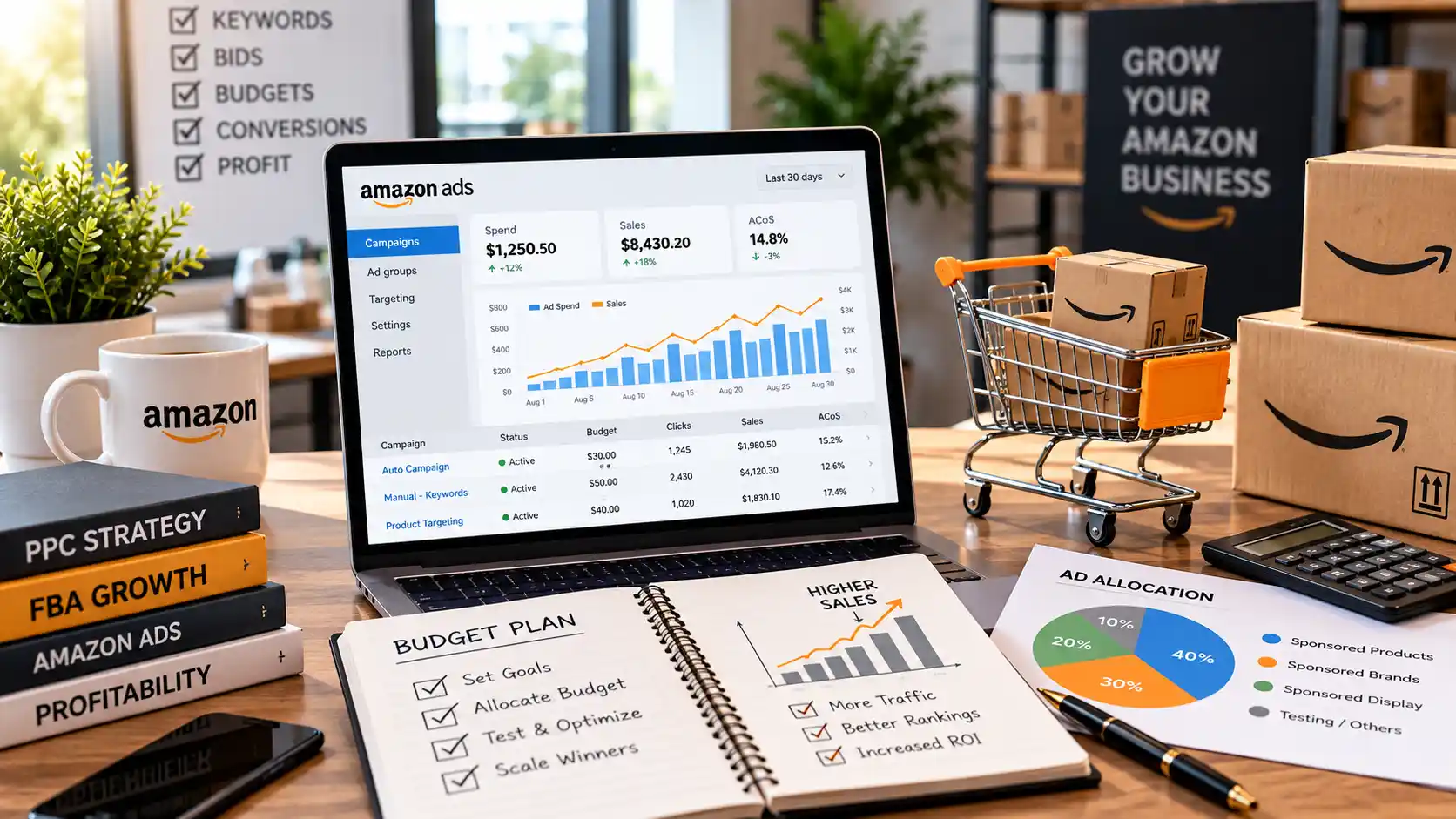
If you are an Amazon FBA seller, you already know that running Pay-Per-Click (PPC) campaigns is no longer an option it is an absolute necessity. The Amazon marketplace is crowded, and relying on organic traffic alone is rarely enough to build a successful brand. However, this reality brings up a major challenge for many sellers: How much money should you actually spend on advertising?
Spend too little, and your products will sit invisibly on page ten of the search results. Spend too much without a clear plan, and your ad costs will quickly swallow your profit margins.
At Advertising Spire, we see sellers struggle with this balance every single day. To succeed and grow your business, you need a data-driven Amazon PPC budget strategy.
In this comprehensive guide, we will break down exactly how you should budget for your Amazon ads. We will walk you through precise product margin calculation, finding your break-even point, setting up daily budgets, handling new product launches, managing inventory, and safely scaling your campaigns.
Why You Need a Defined Amazon Advertising Budget Allocation
Many beginners simply turn on an auto-campaign, set a random $10 daily limit, and hope for the best. This is not a strategy; this is gambling. A well-planned amazon advertising budget allocation gives you absolute control over your business.
Having a concrete budget strategy allows you to:
- Protect Your Cash Flow: Ensure you have enough money to reorder inventory.
- Secure Your Profit Margins: Stop wasting money on search terms that do not generate sales.
- Gather Meaningful Data: Spend enough to learn exactly what keywords Amazon shoppers use to find your products.
- Achieve Sustainable Growth: Scale up your winning campaigns while achieving long-term amazon PPC profitability.
Let’s dive into the exact, step-by-step process of building a bulletproof ad budget strategy.
Step 1: Start with Accurate Product Margin Calculation
Before you decide how much to spend on Amazon PPC, you must know exactly how much money you make on each unit you sell. This is called your net profit margin. If you skip this product margin calculation, it is impossible to run profitable ad campaigns.
To find your true margin, you must deduct every single cost from your final selling price. These costs typically include:
- Cost of Goods Sold (COGS): This includes manufacturing costs, packaging, and the freight shipping cost to get the product from your supplier to Amazon’s fulfillment centers.
- Amazon Referral Fee: This is Amazon’s “commission” for letting you sell on their platform. It is usually 15% of the selling price, though it varies slightly by category.
- Amazon FBA Fulfillment Fee: The cost Amazon charges to pick, pack, and ship your item to the customer. This is based on the size and weight of your product.
- Miscellaneous Costs: Storage fees, expected return costs, and any prep fees.
Example Margin Calculation Table
Let’s look at a realistic example for a product selling for $30.00.
| Financial Metric | Amount ($) |
|---|---|
| Product Selling Price | $30.00 |
| Less: COGS (Manufacturing + Freight) | -$8.00 |
| Less: Amazon Referral Fee (15%) | -$4.50 |
| Less: Amazon FBA Fulfillment Fee | -$5.50 |
| Less: Misc. Fees (Storage/Returns) | -$1.00 |
| Total Costs to Sell One Unit | $19.00 |
| Net Profit (Before Advertising) | $11.00 |
| Net Profit Margin % ($11 / $30) | 36.6% |
In this scenario, your profit margin before spending a single dollar on PPC is 36.6%. This number is the foundation of your entire Amazon PPC budget strategy.
Step 2: Determine Your Amazon Break Even ACOS
Now that you know your profit margin, you can calculate the most critical metric in Amazon Seller Central: your amazon break even acos (Advertising Cost of Sales).
What is Break-Even ACOS?
Your ACOS tells you how much you spent on ads to generate a sale. The break-even ACOS is the exact point where your advertising spend completely wipes out your profit margin. At this point, you make zero profit, but you also lose zero money.
The formula is incredibly simple:
Break-Even ACOS = Net Profit Margin (Before Ads)
Looking at our table above, the profit margin is 36.6%. Therefore, the break-even ACOS is 36.6%.
Here is how you use this number to guide your strategy:
- If a keyword’s ACOS is above 36.6%: You are losing money on that ad click.
- If a keyword’s ACOS is exactly 36.6%: You are breaking even.
- If a keyword’s ACOS is below 36.6%: You are making a profit on that ad click.
By knowing this limit, you can adjust your keyword bids to ensure your overall ACOS stays below your break-even point, leading to true Amazon PPC profitability.
(Note: During a product launch, you might temporarily accept an ACOS higher than your break-even point. We will explain why in Step 4).
Step 3: Structuring Your Amazon PPC Daily Budget
A question we frequently get at Advertising Spire is: “How do I figure out my amazon ppc daily budget?”
There is no magical flat rate that works for every seller. A $10 daily budget limit might be fine for a cheap accessory, but it will be gone in five minutes if you are selling highly competitive supplements. Instead, use a mathematical formula to find the right starting point for a new campaign.
How to Calculate a Starting Daily Budget
- Estimate your Cost Per Click (CPC): Let’s assume the average cost per click in your niche is $1.50.
- Determine how many clicks you need for one sale: If your product page converts at 10% (meaning 1 out of 10 visitors buys), you need 10 clicks to get 1 sale.
- Math: 10 clicks x $1.50 = $15.00 to acquire one sale.
- Set your daily sales goal for the campaign: If you want this specific campaign to generate 3 sales per day, you must budget for it.
- Math: 3 sales x $15.00 = $45.00.
Therefore, a logical amazon ppc daily budget for this campaign would be $45.00.
Pro Tip: Never set your daily budget so low that your campaign runs out of money by 10:00 AM. Amazon’s algorithm needs your ads to run throughout the whole day to find the highest-converting shoppers. If your budget constantly runs out early, you miss out on evening shoppers who might be more likely to buy. Give the algorithm enough budget to collect proper data.
Step 4: Budgeting for Launch vs Mature Products
Your Amazon PPC budget strategy must adapt to the lifecycle of your product. You cannot treat a brand-new listing the same way you treat a product that has thousands of reviews.
The Product Launch Phase (Months 1-3)
When you first launch a product, it has no reviews and no organic ranking. Your main goal during this phase is not immediate profit. Your goals are visibility, data collection, and sales velocity.
- Higher Daily Budgets: You will need a higher ad spend limit during this phase to force your product to the top of the search results.
- Accepting Higher ACOS: Your ACOS will likely be above your break-even point. This is normal. You are essentially “buying” your organic rank. The more sales you generate through PPC, the higher Amazon will rank you organically.
- Data Collection: You run auto-campaigns and broad match campaigns to discover the exact search terms customers use.
Launch Budget Strategy: Expect to spend all of your profit margins—and potentially dip into your product budget—during the first 30 to 60 days to build momentum.
The Mature Product Phase (Month 4 and beyond)
Once your product is ranking well organically on page one and has accumulated a solid base of reviews, your strategy must shift from aggressive growth to profit harvesting.
- Focus on Profitability: Your primary goal shifts to amazon ad spend optimization.
- Lowering ACOS: Your target ACOS should now be strictly managed to sit 10% to 15% below your break-even ACOS.
- Refining Keywords: You will move away from broad research campaigns and allocate the bulk of your budget to exact-match campaigns featuring your highly profitable keywords.
Strategy Comparison Chart: Launch vs. Mature
| Strategy Element | Launch Phase (0-3 Months) | Mature Phase (4+ Months) |
|---|---|---|
| Primary Goal | Sales velocity, keyword rank, data | Maximum profitability, high ROI |
| Target ACOS | Break-even or above | 10% – 15% below break-even |
| Budget Focus | High daily budget for discovery | Controlled budget on winning keywords |
| Keyword Tactics | Broad and Auto campaigns to explore | Exact match on proven, profitable terms |
| Profit Expectation | Low to zero (reinvesting into rank) | High (harvesting organic & ad sales) |
Step 5: Matching Ad Spend to Inventory Availability
One of the biggest mistakes FBA sellers make is sticking to a rigid ad budget without looking at their warehouse stock. Your Amazon PPC budget strategy must be deeply tied to your inventory levels.
Going “Out of Stock” (OOS) is a nightmare for Amazon sellers. When you run out of stock, your listing disappears. Your organic rank plummets. When you finally restock, you have to spend a massive amount of ad money to regain the ranking you lost.
To avoid this, throttle your ad spend based on your stock levels:
- Healthy Inventory (60+ days of stock): Run your campaigns normally. If a campaign is highly profitable, increase the budget to maximize your sales and organic ranking.
- Low Inventory (Under 30 days of stock): You must slow down your sales velocity so you do not stock out before your next shipment arrives. Do not pause your ads entirely, as pausing completely hurts your Amazon algorithm relevance. Instead:
- Lower your daily budget limits by 30% to 50%.
- Reduce your keyword bids to lower your ad placement.
- Consider raising your product price by $1 or $2. This slows down your daily sales while simultaneously increasing your profit margin per unit.
Step 6: Amazon Ad Spend Optimization and Safe Scaling
Once your campaigns have been running for two to four weeks, you will have accumulated enough data to perform proper amazon ad spend optimization. This is the process of cutting out wasted spend and redirecting that money into keywords that are actually generating profit.
1. Trim the “Bleeders” (Wasted Spend)
Look inside your Campaign Manager for search terms that are getting clicks but no sales.
- Rule of Thumb: If a keyword gets 10 to 15 clicks and zero sales, it is wasting your money.
- Action: Add this specific word as a “Negative Exact” keyword. This stops Amazon from showing your ad for this term, instantly saving your daily budget for better keywords.
2. Tame High ACOS Keywords
Find keywords that are generating sales, but at an ACOS higher than your break-even point.
- Action: Lower the bid on this keyword by 15% to 20%. Let it run for a few more days. If the ACOS drops below break-even, keep it. If it remains unprofitable, lower the bid again or pause the keyword.
3. Safely Scale Winning Campaigns
When you find a campaign that is crushing it—generating lots of sales with an ACOS well below your break-even point—you want to give it more money. However, you must do this safely.
The 20% Scaling Rule:
Never double a campaign’s budget overnight. If a campaign is performing beautifully at $30 a day, jumping the budget immediately to $100 a day can reset Amazon’s algorithm, causing your ACOS to spike out of control.
Instead, increase the budget gradually by 20% every few days:
- Day 1: Increase budget from $30 to $36.
- Day 4: Check data. If ACOS remains low, increase from $36 to $43.
- Day 7: Check data. If ACOS remains low, increase from $43 to $51.
This slow scaling tells Amazon’s algorithm to find more of the same high-quality buyers, rather than aggressively overpaying for bad traffic just to spend your new, larger budget.
Weekly Optimization Routine
| Optimization Task | Action Required | Recommended Frequency |
|---|---|---|
| Review Search Terms | Add non-converting words as negative exact keywords. | Twice a week |
| Adjust Bids | Lower bids on ACOS > Break-even. Raise bids on low ACOS. | Once a week |
| Scale Budgets | Apply the 20% rule to increase budgets on profitable campaigns. | Once a week |
| Monitor Inventory | Ensure current ad sales velocity matches remaining stock. | Once a week |
Conclusion: Take Control of Your Amazon Ads Today
Building a successful Amazon PPC budget strategy does not require you to guess, and it does not require you to be a math genius. It simply requires discipline, consistency, and a clear understanding of your business numbers.
By taking the time to accurately calculate your product margins, determining your break-even ACOS, and actively adjusting your daily budgets based on your product lifecycle and inventory, you can stop throwing money away. Instead, you will turn every dollar you spend on ads into a powerful tool for scaling your brand.
Remember, advertising on Amazon is an investment. When managed properly through careful amazon ad spend optimization, that investment will yield massive returns in both ad sales and organic rank.
If managing daily budgets, adjusting bids, and tracking ACOS feels overwhelming, you do not have to do it alone. The team of experts at Advertising Spire specializes in maximizing FBA ad allocation so you can focus on growing your brand.
Visit Advertising Spire today to discover how we can build, manage, and scale a highly profitable Amazon PPC strategy tailored exactly to your products.