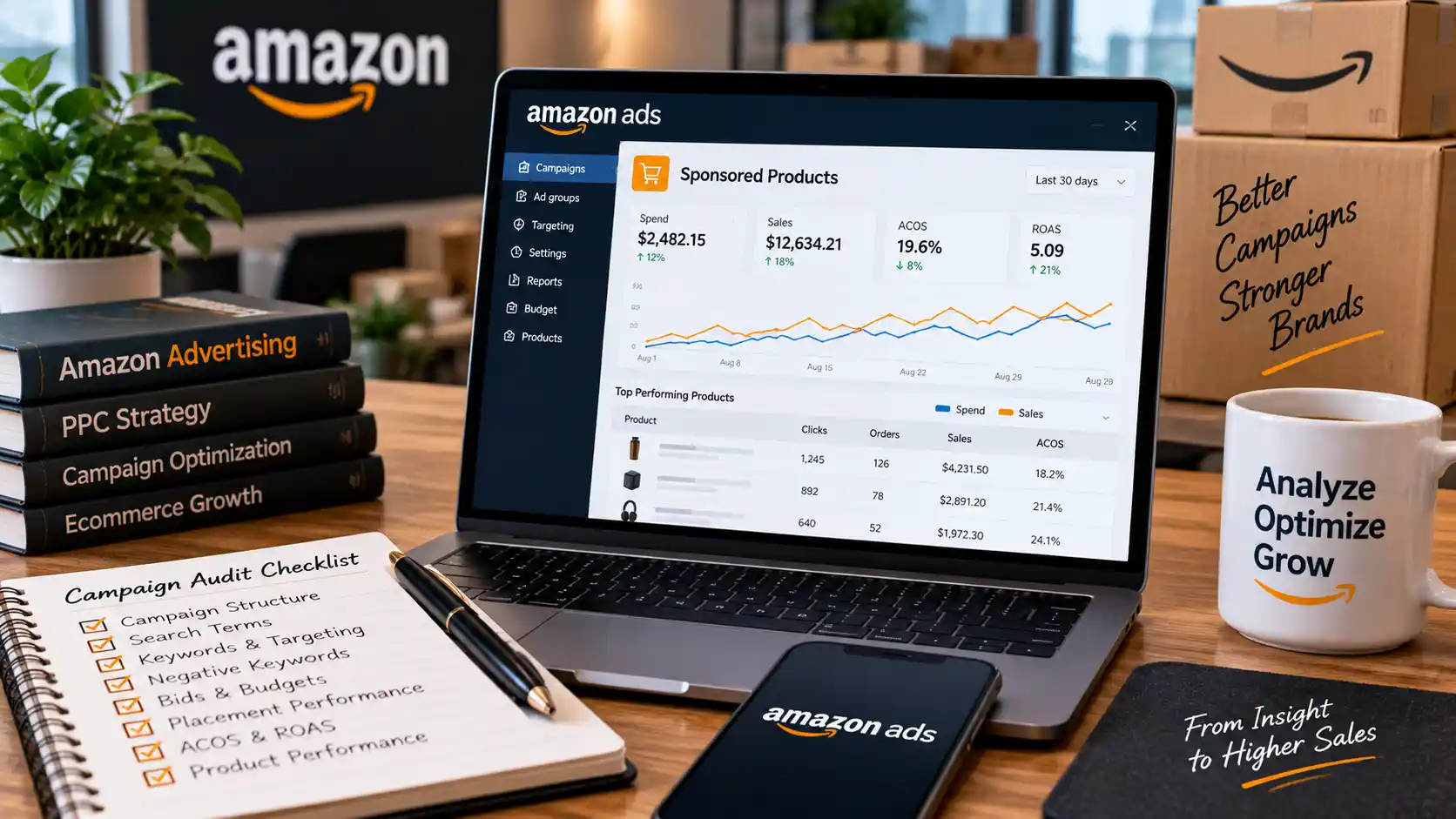
Summary:
“Running Amazon ads but not seeing the ROI you want? An Amazon sponsored products campaign audit is the key to finding wasted spend. Learn how to optimize bids, check search terms, and scale your profits.“
Selling on Amazon is more competitive than ever. If you are already spending money on Amazon ads, you know how quickly a badly managed campaign can drain your budget. Bids get expensive, search terms become irrelevant, and profit margins shrink.
To fix this, brands need to perform a regular Amazon sponsored products campaign audit.
An audit acts as a diagnostic check-up for your advertising efforts. It helps you uncover hidden profit leaks, scale what works, and pause what does not. In this detailed guide, we will walk you through the exact steps to check your campaign health, analyze search terms, audit keywords, and optimize your bids and placements.
What is an Amazon Sponsored Ads Audit?
An amazon sponsored ads audit is a complete, data-driven review of your advertising account. Instead of blindly lowering bids or pausing campaigns, an audit allows you to look at the math behind your ads.
You review the entire structure of your account, looking for areas where your Advertising Cost of Sales (ACoS) is too high, or where your ads are not showing up at all. A proper audit bridges the gap between wasted spend and peak profitability.
If you feel overwhelmed by your ad data, getting a professional Amazon PPC Audit from a specialized agency like Advertising Spire can give you a clear roadmap to success.
Step 1: Perform a Campaign Health Check
Before looking at individual keywords, you must look at the big picture. An amazon PPC campaign review starts with a general campaign health check.
Check Your Budgets
Are your campaigns running out of budget by 2:00 PM? If a profitable campaign pauses early in the day because it hits its budget cap, you are losing sales.
- Action: Filter your campaigns by “Out of Budget.” Increase the budgets on campaigns that have a low ACoS and are highly profitable.
Review ACoS vs. TACoS
- ACoS (Advertising Cost of Sales): This tells you how much you spend on ads to generate an ad sale.
- TACoS (Total Advertising Cost of Sales): This measures your ad spend against your total overall sales (organic + ad sales).
- Action: If your ACoS is high but your TACoS is low, your ads are successfully driving organic ranking. If both are high, your campaigns are bleeding money and need immediate fixing.
Campaign Structure
Check how your campaigns are grouped. Are you mixing completely different products in one campaign? You should group similar products together. One product per campaign (or one tight variation family) gives you the best control over your budget.
Step 2: Deep Dive into Search Term Analysis
There is a big difference between a keyword (what you bid on) and a search term (what the customer actually types into Amazon). Reviewing your Search Term Report is the most important part of any audit.
Download your Search Term Report for the last 30 to 60 days. Sort the data by “Spend.”
Harvesting Winning Search Terms
Look for search terms that have generated multiple sales at an acceptable ACoS. These are your winners.
- Action: Take these highly profitable search terms and put them into an Exact Match campaign. This allows you to control the bid and placement specifically for that winning term.
Negating Bleeding Search Terms
Look for search terms that have a high amount of clicks but zero sales. You are paying for this traffic, but customers are not buying.
- Action: Add these terms as Negative Keywords. This tells Amazon to stop showing your ad when a customer types that exact phrase.
Table 1: Search Term Audit Action Plan
| Metric (Clicks / Sales) | ACoS Level | Action Required |
|---|---|---|
| High Clicks / High Sales | Low ACoS (Profitable) | Harvest: Move to Exact match, increase bid. |
| High Clicks / Low Sales | High ACoS (Unprofitable) | Optimize: Lower the bid slightly. |
| High Clicks / ZERO Sales | N/A (Wasted Spend) | Negate: Add as a Negative Exact keyword. |
| Low Clicks / Low Sales | N/A | Monitor: Wait for more data. |
Step 3: Conduct an Amazon Keyword Audit & Match Type Review
Once you have cleaned up your search terms, the next step is an amazon keyword audit. Are you using the right match types?
Amazon offers three main keyword match types:
- Broad Match: Reaches the widest audience. The customer’s search can include words before, after, or between your keyword.
- Audit Tip: Broad match is great for discovering new search terms, but it easily wastes money. Check broad campaigns frequently to add negative keywords.
- Phrase Match: The search term must contain your exact phrase, but can have words before or after it.
- Audit Tip: This offers a balance of control and discovery.
- Exact Match: The customer’s search must exactly match your keyword.
- Audit Tip: This is where your proven, high-converting keywords should live. You should allocate the largest portion of your budget here.
During your audit, check if your ad groups are properly separated by match type. Mixing Broad, Phrase, and Exact keywords in the same ad group confuses Amazon’s algorithm and makes it impossible to optimize budgets.
Step 4: Master Bid Optimization
Sponsored products optimization relies heavily on setting the right bids. Bidding too high wastes your profit margins; bidding too low means your ads will never be seen.
During your audit, stop guessing your bids. Instead, use math to find the perfect Cost Per Click (CPC).
The Target Bid Formula:Target Bid = Retail Price × Target ACoS × Conversion Rate
Example:
- Your product sells for $30.
- Your target ACoS is 25%.
- Your keyword conversion rate is 10%.
- Calculation: $30 × 0.25 × 0.10 = $0.75 Target Bid.
If your current bid is $1.50 for this keyword, you are overpaying. Lower your bid closer to $0.75. If you are bidding $0.30 but getting no impressions, increase it.
Check Dynamic Bidding Settings
Amazon offers three bidding strategies:
- Dynamic Bids – Down Only: Amazon lowers your bid if a sale is unlikely. (Safest setting for new campaigns).
- Dynamic Bids – Up and Down: Amazon will raise your bid by up to 100% if a sale is likely. (Only use this if you have highly optimized, mature campaigns).
- Fixed Bids: Amazon uses your exact bid every time.
During your audit, ensure your standard campaigns are set to “Down Only” unless you have specifically chosen to test “Up and Down.”
Step 5: Execute Placement Optimization
Not all ad placements are equal. Amazon allows you to show your Sponsored Products in three places:
- Top of Search (TOS): The very first row of search results.
- Rest of Search (ROS): Middle or bottom of page one, or page two and beyond.
- Product Pages (PP): On your competitors’ actual product listings.
As part of your amazon sponsored products campaign audit, go to the “Placements” tab in your campaign manager. Look at the data.
Chart: Example of Placement Performance
| Placement | Spend | Sales | RoAS | Conversion Rate |
|---|---|---|---|---|
| Top of Search | $150 | $900 | 6.0 | 18% |
| Rest of Search | $100 | $300 | 3.0 | 7% |
| Product Pages | $100 | $200 | 2.0 | 4% |
In the example above, Top of Search converts at 18%, while Product Pages convert at just 4%.
- Action: You can use “Placement Multipliers” to tell Amazon to increase your bid by a certain percentage (e.g., +50%) only when your ad has a chance to appear at the Top of Search. This ensures you spend your budget where it converts the best.
Common Amazon Advertising Mistakes to Avoid
When performing your audit, keep an eye out for these frequent amazon advertising mistakes:
- The “Set and Forget” Mentality: Amazon is a dynamic marketplace. Competitors change prices, new products launch, and search trends shift. Checking your ads once a month is not enough. You need weekly optimizations.
- Ignoring Negative Keywords: If you do not actively add negative keywords to your auto and broad campaigns, Amazon will keep spending your money on irrelevant terms.
- Bidding on Highly Competitive Keywords Too Early: If you have a new product with zero reviews, bidding on short-tail, highly competitive keywords will result in a terrible ACoS. Start with long-tail, specific keywords.
- Bad Listing Optimization: Ads only drive traffic; your product listing drives the sale. If your ad gets a lot of clicks but zero sales, your ad is working, but your listing is failing. Ensure your images, title, and bullet points are fully optimized.
- Not Using Portfolios: Portfolios allow you to group campaigns by brand, category, or season and apply account-level budget caps. Failing to use them makes account management messy.
Sponsored Products Optimization: Next Steps
Conducting a thorough Amazon Sponsored Products campaign audit takes time, patience, and a deep understanding of data. However, the reward is massive. By cutting wasted spend, refining match types, and optimizing your bids, you can drastically lower your ACoS and increase your total profits.
If you are a brand owner whose time is better spent on product development and big-picture growth, managing PPC daily can be a burden.
That is where expert help comes in. At Advertising Spire, we specialize in comprehensive Amazon PPC Management. We handle the audits, the bid optimization, the keyword harvesting, and the negative keyword management so you can focus on scaling your brand.
Stop letting wasted ad spend eat into your margins. Use this audit guide to clean up your account today, and watch your profitability soar.