Most sellers only look at their ads when something feels wrong. Sales dip, ACoS climbs, and suddenly they’re scrolling through Campaign Manager at 11pm hoping something jumps out.
A proper Amazon PPC audit turns that guesswork into a list. You find out what’s wasting money, what’s quietly working, and what to change first. We run these for brands every week, and the same handful of problems keep showing up. Here’s what we look at, in the order we usually look at it.
1. Spend with nothing to show for it
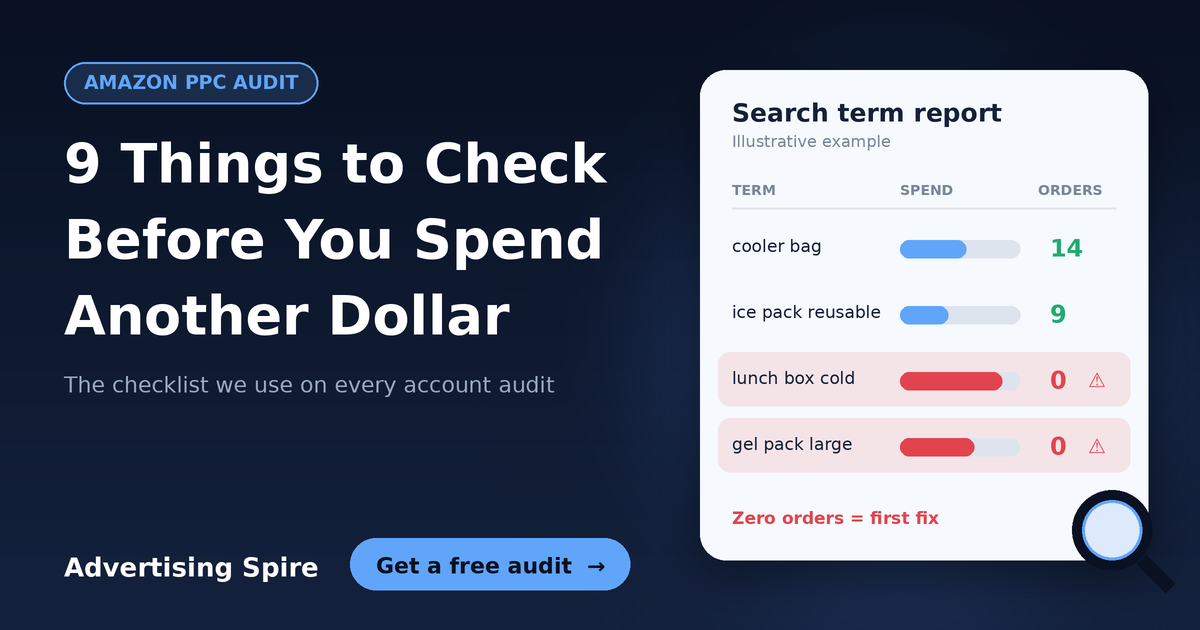
Open your search term report and sort by spend, highest first. Then filter to terms with zero orders. Some of those are fine, because a term might just need more time. But when a term has burned through the price of several sales without converting once, it’s a leak.
This is almost always the fastest win in an audit, and it costs nothing to fix. We covered the usual culprits in 7 Amazon PPC Mistakes That Are Wasting Your Budget.
2. Your winners, and whether they’re being starved
The mirror image of waste is underfunding. Look for campaigns with a strong conversion rate that run out of budget early in the day. Every hour they’re off is a stretch of sales you didn’t get.
It’s a surprisingly common finding. One Amazon seller told us the agency before us had been spending far too little on the winners while money drained elsewhere. Moving budget from the second group to the first is often the single biggest change in the first month.
3. How your campaigns are structured
Ask yourself: does each campaign have one clear job? Auto campaigns are for discovering search terms. Exact match is for protecting the terms you know convert. Product and category targeting is for going after competitors’ customers.
When everything is mixed in one or two campaigns, you can’t tell what’s working, and you can’t set the right bid for each purpose. Cleaning up structure isn’t glamorous, but it makes every later decision easier.
4. ACoS and TACoS, side by side
ACoS tells you how efficient your ads are. TACoS tells you what ads cost against your total revenue, organic included. You need both.
A high ACoS isn’t automatically bad if the campaign is launching a product and lifting organic rank. A low ACoS isn’t automatically good if you’re only advertising on terms you’d rank for anyway. We look at where TACoS has been heading over several months. If it’s flat or climbing while spend rises, the ads aren’t building anything lasting.
5. Match types and keyword overlap
If the same term appears in several campaigns, they compete with each other and you bid against yourself. We check for overlap between broad, phrase, and exact campaigns, and make sure terms that have proven themselves are being graduated into exact match instead of living forever in auto.
6. Placement and bidding
Top of search, product pages, and the rest of search all behave differently. Some accounts pay a large premium for top-of-search placement without checking whether it converts better than the cheaper spots. We look at the numbers by placement and adjust the bids to match what actually earns profit.
7. The listing itself
Here’s the part sellers often skip. Ads send traffic to your listing. If the main image is weak, the price is off, or reviews are thin, a better bid won’t fix it. You’ll just buy more visitors who leave.
That’s why our audit covers both ads and listings. Check your title, images, bullets, A+ content, and rating against your top two or three competitors. Honest side-by-side comparisons are uncomfortable and extremely useful.
8. Inventory and ad timing
Advertising a product that’s about to sell out wastes money and can hurt ranking when stock runs dry. We cross-check campaigns against inventory levels, which is also why we offer supply chain forecasting for brands that keep running into this.
9. Whether anyone is paying attention
This one doesn’t show up in a report, but it matters. When did someone last change your campaigns on purpose? Automation helps, but accounts left on autopilot drift. Tools can’t tell you that a product page changed, or that a competitor dropped their price this week. A person looking at the account regularly can.
What an audit usually finds
We don’t want to promise numbers we can’t see yet, because every account is different. In general, though, we tend to find a combination of the same things: some budget going to terms that never convert, some budget missing from the ones that do, a structure that’s hard to read, and a listing that isn’t helping the ads. For a sense of what fixing those looks like at scale, see how we took an ice pack brand from $0.9M to $3.7M in sales, or browse our other case studies.
Can you do this yourself?
Yes, at least the first few points. Download your search term report, check spend against orders, and look at your TACoS trend over the last three to six months. You’ll learn something about your account in an hour.
Where it gets harder is the judgment calls: which terms to cut and which to give more time, how to restructure without wrecking what’s working, and how the ads and the listing interact. That’s where a second pair of eyes saves months of trial and error.
Quick answers
What is an Amazon PPC audit?
A review of your ad campaigns, and ideally your listings too, to find wasted spend, missed opportunities, and structural problems.
How often should I audit my Amazon PPC?
At least quarterly, and before big events like Prime Day or Black Friday. A quick weekly check of your search term report helps too.
What’s a good ACoS?
It depends on your margins and goals. A product with a 30% margin can’t live with the same ACoS as one with a 50% margin, which is why we compare ACoS to TACoS and profit, not to a universal number.
Is the audit really free?
Yes. There’s no obligation. You get a clear picture of your account and what we’d do first.
What do I need to share?
Contact us and we’ll walk you through what we need to get started.
Get a free look at your account
Our Listing and PPC Audit goes through the points above for your listings and campaigns, and gives you a clear, prioritized list of changes. It takes the guesswork out of what to fix first.
Request your free audit, or if you’d rather talk it through first, contact the team. If you decide you want help acting on what we find, we also offer full Amazon PPC management.