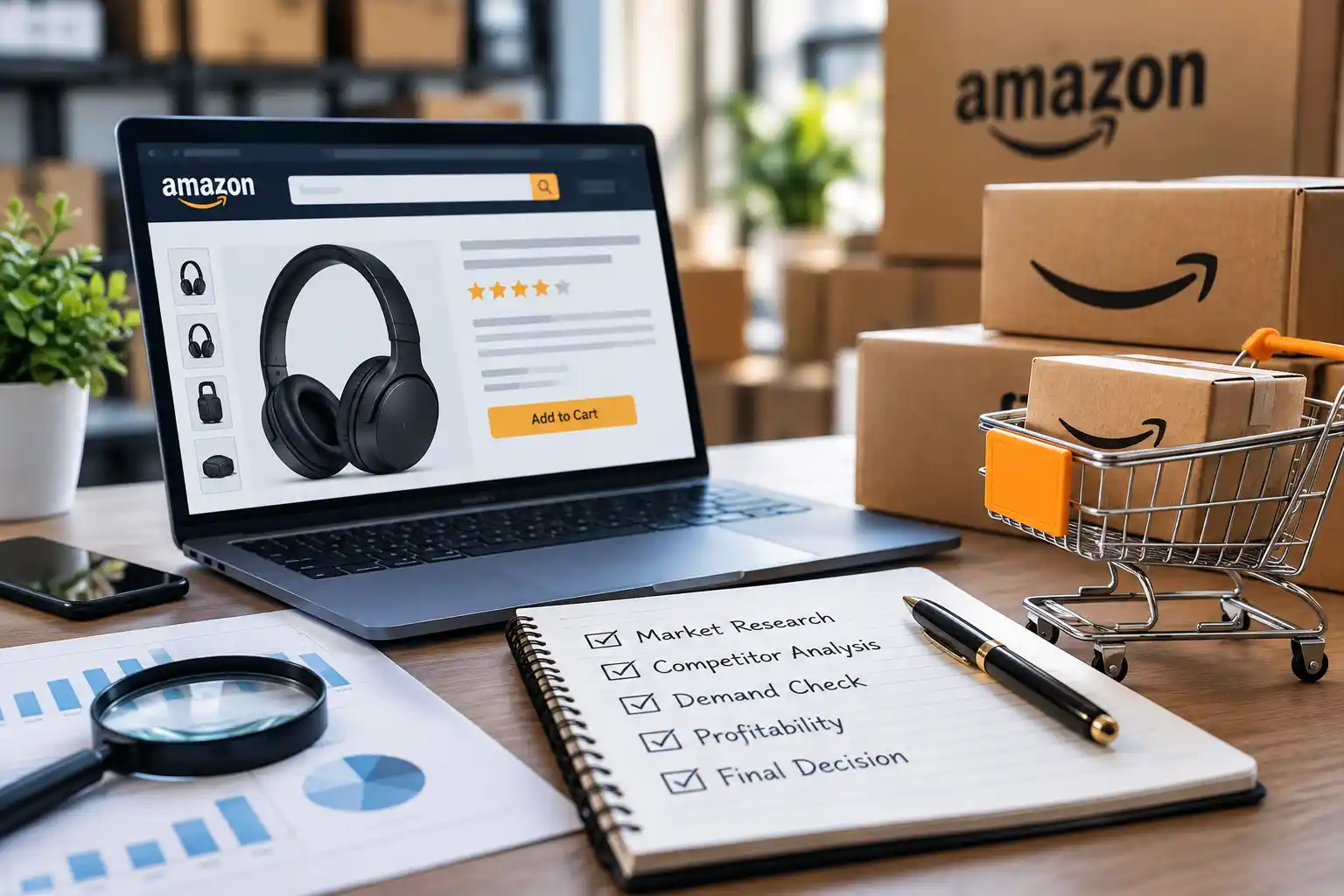
Summary:
“Launching a product on Amazon without research is a quick way to lose money. This guide covers how to validate market demand, analyze competition, and calculate profit margins. Learn the exact steps to ensure your next FBA product is a profitable winner.“
Every day, new entrepreneurs join the Amazon marketplace with big dreams and a healthy budget. They scroll through wholesale websites, find a product that looks interesting, order a thousand units, and wait for the sales to roll in. Unfortunately, a few months later, their inventory is collecting dust in an Amazon fulfillment center, eating away at their capital through monthly storage fees.
Why does this happen so frequently? These sellers skipped the most crucial step of building an Amazon business: data-backed research.
New sellers consistently lose money by launching products without proving that customers actually want to buy them. If you want to build a successful FBA (Fulfillment by Amazon) business, you must rely on hard data, not gut feelings. Utilizing a professional amazon product validation service before launch or learning the meticulous steps to do it yourself is the absolute best way to protect your investment.
In this detailed guide by Advertising Spire, we will walk you through exactly how to validate an Amazon product before hitting the launch button. We will cover how to accurately gauge market demand, conduct a competitor analysis, forecast profit margins, spot keyword opportunities, and identify hidden launch risks.
The Importance of Ecommerce Product Idea Validation
Before diving into the exact steps of the validation process, it is important to understand what validation actually means in the context of Amazon FBA.
Ecommerce product idea validation is the strict process of using real market data to prove that a product idea has high consumer demand, low to medium competition, and a profit margin large enough to sustain your business. You are essentially trying to poke holes in your own product idea to see if it survives.
When you validate a product, you must look at specific entities and metrics:
- Best Sellers Rank (BSR): How fast is the product currently selling?
- Search Volume: How many people are actively typing this exact product into the Amazon search bar every month?
- Review Count: Is the market so dominated by established sellers that a newcomer cannot compete?
- Cost of Goods Sold (COGS): Can you source, ship, and sell this item cheaply enough to turn a profit after Amazon takes its cut?
Skipping this step leads to bloated advertising costs, stagnant inventory, and ultimate failure. Proper product market validation for amazon fba sellers removes human emotion from the equation. Let’s look at the five non-negotiable steps you need to take to validate your next product.
Step 1: Analyze Market Demand and Sales Velocity
A product might look incredible, solve a unique problem, and have a beautiful design. However, if nobody is searching for it on Amazon, it will not sell. Your first goal in profitable amazon product research is to ensure there is a healthy, consistent, and active demand for the item.
Check the Best Sellers Rank (BSR)
Every product sold on Amazon is assigned a BSR within its main category and sub-categories. The lower the BSR number, the faster the product is selling. For example, a product with a BSR of 1,000 in the “Home & Kitchen” category sells significantly more units per day than a product with a BSR of 50,000 in that same category.
To validate demand, search for your main keyword and look at the top 10 organic sellers on page one. If the majority of them have a main category BSR under 10,000 to 15,000, you know the market has a strong, ongoing sales velocity. If the top sellers have poor BSRs, it means the overall market demand is too low to support a new competitor.
Evaluate Seasonality and Trends
You must avoid products that only sell for one specific month out of the year, especially if it is your first launch. A Halloween decoration will have massive demand in October and near-zero demand in April. If you mismanage your inventory, you will be stuck paying storage fees for 11 months.
Use tools like Google Trends or Amazon-specific research software to look at the sales history over the last 12 to 24 months. You want a product with a steady, stable sales graph year-round.
Step 2: Conduct a Thorough Competition Analysis
High demand is excellent, but if a market is dominated by massive household brands with thousands of reviews, you will struggle to get noticed. You need to find a gap in the market where a new seller can realistically compete.
The Review Barrier
Reviews are the ultimate social proof that drives Amazon sales. Look at the page one search results for your product idea. If the top 10 sellers all have 5,000+ reviews and 4.8-star averages, that market is overly saturated.
As a new seller launching with zero reviews, you want to see at least 3 to 4 sellers on the first page with fewer than 300 reviews who are still making strong daily sales. This proves that newer listings are capable of taking market share away from older listings.
Listing Quality Score
Next, analyze your competitors’ product listings. Are they fully optimized? Look for weaknesses you can exploit:
- Poorly lit, low-resolution main images.
- Only 2 or 3 images used instead of the allowed 7.
- Short, uninformative bullet points that do not explain the product’s benefits.
- No A+ Content (Enhanced Brand Content) in the description.
- A lack of video content demonstrating how the product works.
If top competitors have weak listings, you have found a prime opportunity. You can easily outrank and out-convert them simply by creating a highly optimized, professional listing.
Table: Competitor Analysis Checklist
| Metric | Ideal Target for New Sellers | Red Flag (Avoid) |
|---|---|---|
| Top 10 Average Reviews | Under 500 reviews | 2,500+ reviews on all top listings |
| Selling Price Range | $25 – $60 | Under $15 (Extremely hard to profit) |
| Listing Quality on Page 1 | 2-3 weak or unoptimized listings | All top 10 have perfect A+ and video |
| Brand Dominance | Multiple different brands selling well | 1 brand owns 50%+ of Page 1 real estate |
Step 3: Calculate Your Profit Margins Accurately
You can find a product with massive demand and incredibly low competition, but if the numbers do not make sense, it is not a viable product. Many sellers forget to calculate their exact landed costs and Amazon fees, which quickly leads to negative margins.
The “Rule of Thirds”
When conducting an amazon product feasibility analysis, a good benchmark for beginners is the “Rule of Thirds.” Your final selling price should roughly break down into the following categories:
- 33% for Landed Cost: This includes the cost of manufacturing, custom packaging, and the freight shipping cost to get the product from your supplier to the Amazon warehouse.
- 33% for Amazon Fees: This covers the FBA fulfillment fee (picking, packing, and shipping to the customer) and the Amazon referral fee (usually a flat 15% commission on the sale price).
- 33% for Profit & Marketing: This is your gross margin, which will be used to fund your Amazon PPC advertising campaigns and your actual take-home profit.
Calculating True Landed Cost
Do not just look at the raw price per unit on a sourcing website like Alibaba. You must calculate the true landed cost. This means factoring in ocean or air freight, customs duties, tariffs, and Amazon’s inbound placement fees. To manage this properly as you scale, you must master Supply Chain Forecasting so you do not run out of stock or overpay for rushed air shipping just to keep your listing active.
Chart: Example Profit Margin Breakdown (Selling Price: $40.00)
| Expense Category | Estimated Cost | Percentage of Sale |
|---|---|---|
| Manufacturing Cost (COGS) | $8.00 | 20% |
| Shipping to Amazon (Freight) | $3.20 | 8% |
| Amazon Referral Fee (15%) | $6.00 | 15% |
| Amazon FBA Fulfillment Fee | $6.80 | 17% |
| Gross Profit (Before PPC) | $16.00 | 40% |
Note: You ideally want your gross profit margin (Return on Investment) to be at least 30% to 40% before advertising. This gives you enough financial breathing room to spend on ads to rank your product and still remain profitable.
Step 4: Evaluate Keyword Opportunity
Amazon functions as a massive, highly targeted search engine. Shoppers type specific keywords into the search bar, and Amazon’s A9 algorithm decides which products are the most relevant to show them. Because of this, your product validation process must include deep keyword research.
Search Volume vs. Competing Products
You need to find a primary keyword that has a high search volume but a relatively low number of competing products in the search results.
For example, if you search for the broad term “Yoga Mat,” you might see over 50,000 competing products. It will be incredibly expensive and difficult to rank on page one for that word. However, if you search for “Extra Thick Non-Slip Yoga Mat for Bad Knees,” you might find high monthly search volume but only 1,000 competing products. This is called a long-tail keyword opportunity.
If your product idea relies entirely on one broad, highly competitive keyword, your advertising costs will eat all of your profits during launch. A properly validated product should have 10 to 15 highly relevant long-tail keywords that you can target easily and affordably.
Once you validate these keywords, managing them during your actual launch becomes the next critical phase. Proper Amazon PPC Management is required to ensure you bid efficiently on these exact keywords without wasting your daily budget on irrelevant search terms.
Step 5: Identify and Mitigate Launch Risks
The final step in ecommerce product idea validation is checking for roadblocks that could get your listing suspended or your inventory destroyed. Launch risks are the hidden traps that catch new and eager sellers entirely off guard. Before you ever pay a supplier, check for the following:
1. Patents and Trademarks
Never launch a product without checking for utility and design patents. If you copy a patented product, the patent holder will quickly report you to Amazon. Your listing will be taken down, your funds will be frozen, and you may lose all your inventory. Always hire a specialized patent lawyer on a freelance platform to do a comprehensive search before you commit to manufacturing.
2. Gated Categories
Some categories on Amazon are “gated,” meaning you need special approval and documentation to sell in them. Categories like Dietary Supplements, Topicals, Toys, and Grocery require certificates of analysis, supplier invoices, and strict FDA compliance. If you are a beginner, it is best to stick to ungated categories like Home & Kitchen, Office Products, or Pet Supplies to avoid lengthy launch delays.
3. Hazmat (Hazardous Materials)
Products containing lithium batteries, flammable liquids, or compressed gases are classified as Hazmat. Amazon has very strict rules, highly limited storage space, and higher fees for Hazmat items. During your validation phase, use the Amazon FBA Revenue Calculator to check if your product falls under a dangerous goods classification.
4. Size and Weight Tiers
Oversized products carry massive FBA storage and fulfillment fees. A product might seem cheap to manufacture, but if it is long, bulky, or heavy, the shipping and FBA fees will completely destroy your margins. Stick to products that fit inside a standard shoebox and weigh under 2 to 3 pounds for your first launch to keep logistics simple and affordable.
Why Invest in an Amazon Product Research Service?
Validating an Amazon product is an intensive process. It requires a deep understanding of data analytics, competitor psychology, patent law, and Amazon’s complex fee structures. While you can learn to do this yourself, one simple mistake in reading the data can cost you thousands of dollars in unsellable inventory.
This is exactly why many smart, successful sellers utilize an amazon product validation service before launch. A professional amazon product research service takes the dangerous guesswork out of the equation.
At Advertising Spire, we understand the exact metrics required to succeed on the modern Amazon platform. Our team conducts deep-dive research into market trends, historical BSR data, and competitor weaknesses. We do the heavy lifting to ensure your product idea is structurally sound, legally safe, and mathematically profitable.
By utilizing expert Product Validation services, you gain access to:
- Accurate sales estimates and demand forecasting based on premium software tools.
- Precise profit margin calculations including all hidden Amazon fees and logistics costs.
- A detailed breakdown of the exact long-tail keywords you will need to target for a successful launch.
- Peace of mind knowing your financial investment is backed by hard, irrefutable data.
Conclusion
Launching an Amazon FBA business is an incredible way to build sustainable wealth, but it is not a get-rich-quick scheme. The days of throwing a random product onto the platform and making thousands of dollars overnight are long gone. Today, success requires meticulous amazon product feasibility analysis.
To summarize, before you wire any money to a supplier, you must verify the following:
- Prove the market demand: Ensure consistent sales velocity using BSR and search volume history.
- Evaluate the competition: Confirm you can actually beat the competition’s review counts and listing quality.
- Run the numbers: Calculate your true landed costs and ROI to ensure you have a minimum 30% to 40% gross margin.
- Analyze search terms: Find profitable long-tail keyword opportunities to keep PPC costs low.
- Audit for risks: Check for active patents, Hazmat restrictions, category gating, and oversized fees.
Do not let excitement cloud your business judgment. Take the necessary time to analyze the data, or partner with an amazon product validation service before launch to guarantee you are making the right choice. When you launch a thoroughly validated product, you set your FBA business up for long-term, scalable, and stress-free profitability.
Ready to find your next winning product without the guesswork? Visit Advertising Spire today to learn how our expert Amazon services can take your e-commerce brand to the next level.