Bringing high-intent traffic to your Amazon product detail pages is only half the battle. Studies across e-commerce show that over 97% of first-time visitors leave a product page without purchasing. To capture these lost opportunities, implementing effective Amazon retargeting ads is essential.
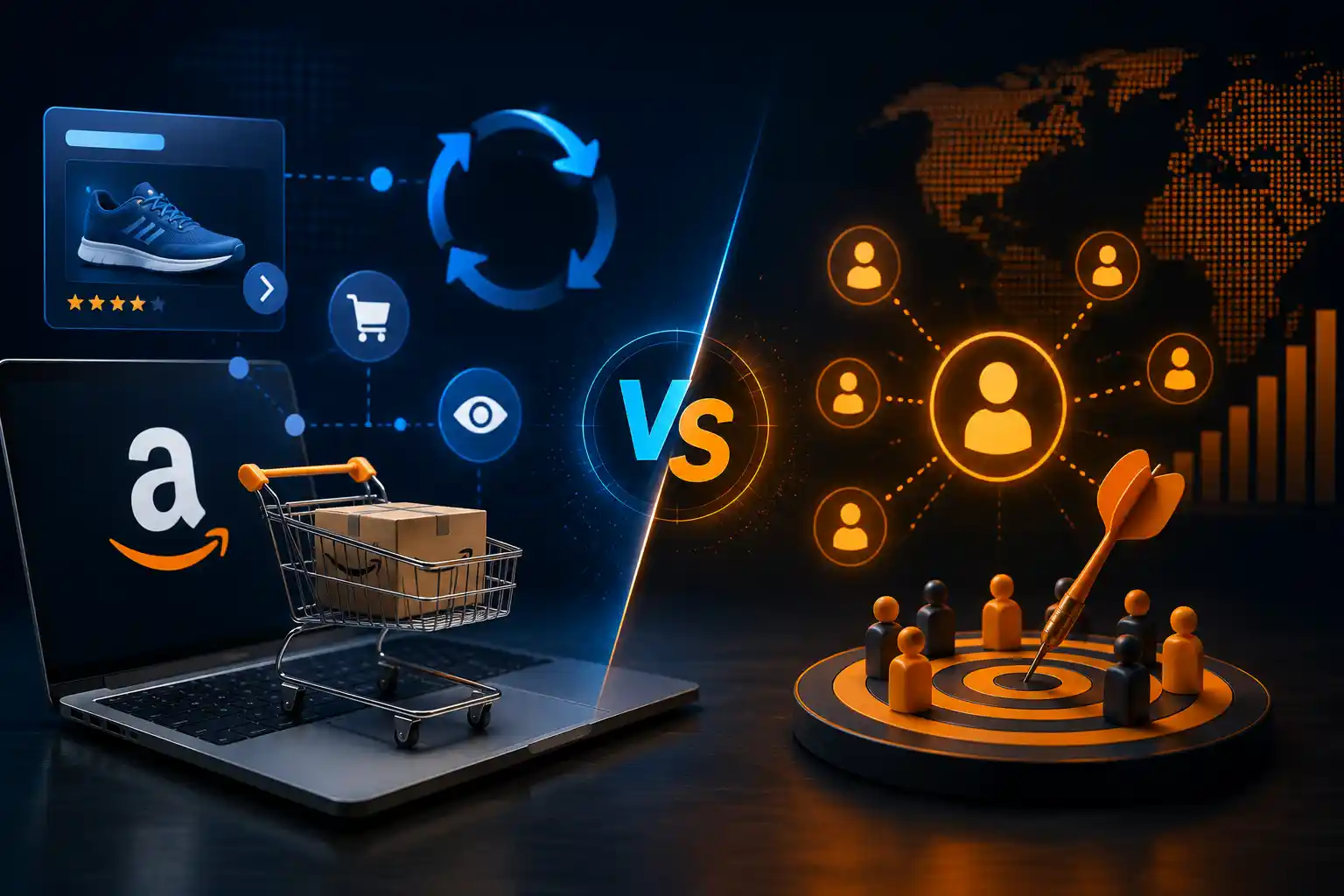
Amazon offers two distinct solutions for audience remarketing: Sponsored Display (SD) audience targeting inside Seller Central or Vendor Central, and Amazon DSP (Demand-Side Platform). While both leverage Amazon’s shopper behavioral data, they serve different operational scales, budget structures, and strategic goals.
At a Glance: Sponsored Display vs. Amazon DSP
| Feature / Metric | Sponsored Display (SD) | Amazon DSP |
| Pricing Model | Cost-Per-Click (CPC) or vCPM | Cost-Per-Mille (CPM / Per 1,000 Impressions) |
| Minimum Budget | No minimum daily spend ($1/day) | $10K–$35K+ /mo (Managed or Enterprise Console) |
| Placement Reach | On Amazon + Select 3rd-Party Apps/Sites | On Amazon, Amazon Owned (IMDb, Twitch, Prime) + Open Web |
| Audience Control | Pre-built behavioral segments (Views, Purchases) | Custom Audiences, Lookalikes, AMC query integration |
| Creative Formats | Auto-generated product cards, basic video/images | Custom HTML5, Responsive E-commerce, Video, CTV/OTT |
| Attribution Window | 14-Day Click-based (or VTR for vCPM) | 14-Day Lookback (Click + Impression Attribution) |
| Best For | Growing brands, self-serve PPC management | Scaling brands, multi-channel strategy, enterprise growth |
1. Minimum Budget & Cost Structure
The most immediate operational difference between Sponsored Display and Amazon DSP lies in entry barriers and billing models.
Sponsored Display
- Low Entry Barrier: Operating directly inside the Amazon Advertising console, Sponsored Display requires no minimum monthly spend. You can start campaigns with daily budgets as low as $5 to $10.
- Pricing Model: Uses standard Cost-Per-Click (CPC) pricing (or vCPM for view-based bidding), making it familiar to managers running standard Sponsored Products or Sponsored Brands campaigns.
Amazon DSP
- Capital Commitment: Programmatic advertising via Amazon DSP operates on a Cost-Per-Mille (CPM) pricing model (cost per 1,000 impressions).
- Managed vs. Self-Serve:
- Managed Service: Managed through Amazon or an agency with access to an enterprise DSP console, requiring monthly commitments starting between $10,000 and $35,000+.
- Self-Serve Accounts: Dedicated self-serve seats avoid per-campaign minimums, but require specialized programmatic media-buying expertise to manage profitably.
For brands seeking immediate PPC optimization without capital lockups, leveraging Amazon PPC Management via Sponsored Display offers maximum operational flexibility.
2. Audience Control & Targeting Granularity
Targeting control dictates how accurately you re-engage high-intent shoppers based on past behavior.
                  AMAZON RETARGETING TARGETING DEPTH

  [ Sponsored Display ]                 [ Amazon DSP ]
  ---------------------                 --------------
  • Views Remarketing (7-90 days)       • Custom Lookback Windows (1-365 days)
  • Purchase Remarketing                • Complex Boolean Logic (AND / OR / NOT)
  • Amazon Category Audiences           • In-Market & Lifestyle Segments
  • In-Market & Interest Groups         • Custom Pixel Data & CRM Uploads
                                        • Amazon Marketing Cloud (AMC) Custom Queries
Sponsored Display Audience Capabilities
Sponsored Display offers standardized Views and Purchases remarketing:
- Views Remarketing: Target consumers who viewed your product pages (or similar products) within a 7, 14, 30, 60, or 90-day window but did not buy.
- Purchases Remarketing: Target past buyers to drive cross-sells, upsells, or repeat purchases over a set time window.
- Limitations: You cannot easily exclude fine-grained behavioral overlaps or build complex exclusion groups without manual negative ASIN additions.
Amazon DSP Audience Capabilities
Amazon DSP unlocks granular, programmatic access to Amazon’s 1st-party customer dataset:
- Custom Lookback Windows: Select precise time ranges (e.g., retarget shoppers who viewed your ASIN in the last 3 days vs. 30 days).
- Advanced Boolean Logic: Combine behaviors using AND, OR, and NOT statements (e.g., Viewed ASIN A AND Viewed Category B BUT Did NOT Purchase ASIN A).
- Cross-Channel & Off-Amazon Integration: Ingest custom advertiser pixels, upload customer CRM lists, and target off-Amazon users based on real-time purchase intent signals.
- Amazon Marketing Cloud (AMC): Query raw event data to construct granular audience segments based on total touchpoints and lifetime value metrics.
3. Creative Freedom and Media Formats
Visual presentation directly impacts Click-Through Rates (CTR) and conversion performance when re-engaging window shoppers off-Amazon.
       CREATIVE FORMAT FLEXIBILITY

  Sponsored Display:
  [ Auto-Generated ASIN Card ] --> Basic Image/Logo --> 45-Sec Video

  Amazon DSP:
  [ Custom HTML5 ] + [ Responsive E-Commerce ] + [ Dynamic Video ] + [ OTT/CTV Ads ]
- Sponsored Display Creatives: Primarily relies on auto-generated ads containing the product image, star rating, price, and prime badge pulled directly from your listing details. While custom background images and short video clips (up to 45 seconds) are supported, layout alterations remain minimal.
- Amazon DSP Creatives: Provides broad display flexibility. Advertisers can utilize Responsive E-commerce Creatives (REC), which automatically iterate backgrounds and calls-to-action based on real-time performance. Additionally, DSP supports custom HTML5 banners, video ads across Prime Video, Twitch, and IMDb, as well as Over-The-Top (OTT) Connected TV placements.
Note: Before investing in off-Amazon retargeting media, verify that your listings are fully optimized to convert incoming traffic. Running a systematic Listing and PPC Audit helps eliminate conversion leaks beforehand.
4. Sales Funnel Positioning & Attribution
Understanding where each ad product sits within the customer buying journey ensures proper KPI evaluation.
                 THE AMAZON RETARGETING SALES FUNNEL

            /-------------------------------------------\
           /               AWARENESS                     \  <-- Amazon DSP (CTV, Video, Twitch)
          /-----------------------------------------------\
         /               CONSIDERATION                     \ <-- Amazon DSP + Sponsored Display
        /---------------------------------------------------\
       /                 CONVERSION                          \ <-- Sponsored Display + DSP Retargeting
      /-------------------------------------------------------\
     /                   LOYALTY & RETENTION                   \ <-- DSP CRM Uploads + SD Purchase Retargeting
    /-----------------------------------------------------------\
Funnel Alignment
- Sponsored Display: Primarily operates at the bottom of the funnel (Conversion) and middle of the funnel (Consideration). It excels at bringing back shoppers who recently viewed your exact ASINs or close category alternatives.
- Amazon DSP: Operates across the entire full funnel (Awareness through Loyalty). While it handles bottom-funnel retargeting effectively, its strength lies in building awareness at scale and guiding users sequentially down the sales funnel.
Expected Attribution Windows & Models
- Sponsored Display Attribution: Uses a standard 14-day click-based attribution model for seller accounts (view-through attribution applies if utilizing vCPM pricing models).
- Amazon DSP Attribution: Employs a comprehensive 14-day lookback window covering both Click-Through and View-Through conversions. View-through metrics track sales driven by shoppers who saw your retargeting display ad on an external website, did not click immediately, but returned to Amazon to buy within 14 days.
5. Reporting Capabilities and Analytics
Data depth dictates how quickly media buyers can optimize campaigns and reduce wasted ad spend.
               REPORTING & ANALYTICS COMPARISON

  [ Sponsored Display Reporting ]        [ Amazon DSP Reporting ]
  -------------------------------        ------------------------
  • Campaign-level Performance           • Granular Site & App Breakdown
  • ASIN-level Matched Targets           • Full Frequency & Reach Metrics
  • Standard Amazon PPC Metrics          • View-Through vs Click Conversions
  • Downloadable CSV Reports             • Custom AMC SQL Data Environment
- Sponsored Display Reporting: Provides standard PPC metrics (ACoS, ROAS, Orders, Impressions, CPC, CTR) inside standard Campaign Manager downloads. While functional, it offers limited visibility into off-Amazon placement performance or ad exposure frequency.
- Amazon DSP Reporting: Delivers enterprise-grade reporting, including domain-level performance, impression delivery times, view-through rates (VTR), brand halo sales, and frequency capping metrics. When integrated with Amazon Demand Side Platform workflows, brands gain deep insights into path-to-purchase customer journeys.
Strategic Verdict: When to Choose SD vs. Amazon DSP
Choosing between Sponsored Display and Amazon DSP is not mutually exclusive—many fast-growing brands leverage both simultaneously. However, clear indicators determine which solution fits your current operational phase.
                       STRATEGIC DECISION MATRIX

                   Is your monthly ad budget > $10,000?
                                   |
                  +----------------+----------------+
                  |                                 |
                 YES                                NO
                  |                                 |
    Do you need off-Amazon CTV,               Use Sponsored Display
    custom HTML5 & AMC data?                  Audience Retargeting
                  |                           inside Seller Central.
         +--------+--------+
         |                 |
        YES               NO
         |                 |
    Deploy Amazon     Scale Sponsored
    DSP Platform       Display + PPC
Choose Sponsored Display Retargeting If:
- Your brand generates under $50,000/month in revenue on Amazon and operates with lean marketing budgets.
- You prefer managed PPC options directly within standard Seller Central or Vendor Central consoles.
- Your primary goal is straightforward product-view retargeting to catch abandoners near the point of purchase.
- You require a low-maintenance setup with automated dynamic creatives.
Upgrade to Amazon DSP If:
- Your brand generates $100,000+/month on Amazon and has exhausted standard search advertising scale.
- You want to re-engage consumers across off-Amazon channels, Twitch, Prime Video, and top digital publishers.
- You require precise lookback windows, dynamic exclusions, and custom CRM list uploading.
- You need full-funnel view-through attribution insights and access to Amazon Marketing Cloud (AMC) analytics.
Next Steps for Execution
Maximizing Amazon retargeting ROI requires matching campaign complexity with your operational scale. Start by deploying Sponsored Display retargeting campaigns to capture lower-funnel demand. As revenue scales, transition to programmatic Amazon DSP media buying to control off-Amazon touchpoints, build custom audience segments, and scale sustainable brand equity.